Tuesday was a day of rest. The plan was to go to London on Wednesday we put that off because Tuesday was not sufficient time to rest our weary bones enough to tackle London. Instead, we opted for a visit to the Duxford Imperial War Museum.
The museum consists of 4 hangers and 3 buildings. This is the view that greets you as you enter the AirSpace Building.
My first Concorde, much smaller than I expected.
I like flying boats. A Short Sutherland Mk V, the white boaty thing on the lower right.
The best shot I could get of a Mosquito.
The Vulcan - mean looking machine. Carried Britain's strategic nuclear weapons from mid 1950's to 1969
Where they kept "The Bomb".
This particular Concorde was one of the first produced and was half-filled with testing equipment. Very claustrophobic inside, but fast, and expensive.
Alexander checking out a pilot training aid.
That white boaty thing again - huge!
The legendary Rolls-Royce Merlin engine. A 27 liter (1650Cu. in.) V-12 engine that produced 1100 horsepower and was named for a bird of prey.
One building housed a work shop where planes were repaired or rebuilt. This is a Spitfire Mark something or other
My home town of Brantford was the site of a pilot training school during the Second World War and I was use to seeing Harvard Trainers still at the airport after the war.
Another flying boat, this one operational. No sign to say what it is.
Another Spitfire in the Battle of Britain Hanger.
A Vosper 60ft wooden motor torpedo boat. She was commissioned in 1940 served both at Felixstowe and Dover protecting British convoys in coastal waters
Another version of a torpedo boat, this one carrying a single torpedo. There was no information on how the torpedo was launched. It would seem that he had to be backed out of the ship and pointed in the right direction and fired off. Accuracy would depend on getting as close to the enemy ship as possible. What was the life expectancy in such a small wooden craft on the high seas?
A wooden Lifeboat, the Jesse Lumb, was commissioned in 1939 and served until 1970. During the Second World War she was called out some 40 times; twice to rescue downed aircrews.
A Focke Achgelis FA 330 Bachstelze (?) A single seat gyro kite used by towed by German submarines and used as an observation platform. One has to wonder what would happen to the observer in the event of a crash dive.
A Fairey Gannet AS6 a carrier borne anti-submarine aircraft used by the British Navy from 1955 to the 1970's. I was intrigued by the double hinged wings.
This Messerschmidt BF109E number 1190 was used in the battles of Britain and France. On 30 September 1940 it's engine failed and it was crash landed in a field near East Dean, Sussex. The pilot was shot as he tried to get out of the plan and was taken captive. A soldier was given the task of protecting the aircraft from scavenging farmers.
The infamous V1 Rocket. Over 10,000 of these were fired at London, but only some 3000 got through the coastal defences, both anti-aircraft guns and fighters. But those 300 killed some 3000 civilians.
This is the only photo I have of this memorial that you pass on the way to the American Pavilion. i should have taken more because the memorial is quite long and depicts the number of aircraft, both bombers and fighters lost in the Second World War
The lighting in the American Pavilion was very poor so I took few photographs. The aircraft on the right is the Lockheed SR71 Blackbird. It is the highest flying and fastest manned jet aircraft. It has flown as high as 85,000 ft.
As we left the last pavilion we were treated to a mini air show as a Spitfire buzzed the field.
Monday, 10 May 2010
Wednesday, 5 May 2010
Monday 12 June - Vimy
On our last day in France we returned to Vimy to view more of the site. Just before reaching the information centre we turned down a small trail to the right and went on to find this cross of remembrance.
The inscription reads,
I could find no information concerning this cross of remembrance and can only assume it was raised by surviving members of the 3rd division.
Canadian Cemetery No. 2, one of two cemeteries at the site.
The Canadian cemetery is a burial ground for commonwealth soldiers killed in the First World War. It was originally named CD5 and was a battlefield cemetery for soldiers of the Fourth Canadian Division killed in the battle of Vimy Ridge.
In 1919 similar battlefield cemeteries were cleared and the remains interred here. It was reopened in 1931 and received the last burial in 1931. The cemetery now contains the graves of 2,965 Commonwealth soldiers.
So many headstones are as the one below, the actual remains are elsewhere.
The weather was a little different than our previous visit, cold and damp.
Part of the underground tunnels have been preserved and are open to the public,
The view from the bottom of the stairs.
It was interesting to see that the green mold only grew around the lights.
Coming up to a pumping station set into the side of the tunnel.The pumps were run continually as flooding would occur without the pumps. Some deaths occurred in the tunnels due to the empty gas cans being used for drinking water. Our guide pointed out that the atmosphere in the tunnels would be fetid and soldiers would consume the gas without smelling or tasting it.
I cannot imagine spending months in these tunnels with little to do, waiting for the order for the attack to go forward.
Areas of the tunnels were shut off from the public due to dangerous conditions. The soldiers were fortunate in this area to be digging in chalk, no reinforcement was required to shore up the tunnels.
In other areas the tunnels had to be dug through clay, which required the tunnels to be completely planked with wood, roof and walls. Timber precut to the required dimensions was supplied from as far away as Ottawa, Ontario.
We only spent 30 minutes below ground but it was enough for me; one reason being that I was continually bumping my head on cross beams. Tunnels and trenches were dug just deep enough for the average height of a soldier at the turn of the century, 5'6". Life expectancy for taller soldiers was far shorter, especially in the trenches where German snipers were constantly looking for targets.
If you look closely you will see the Vimy memorial in the distance. Our last view after a memorable trip to France and Belgium.
And my last view of Europe as we made out way home. I enjoyed watching the seagulls hitch a ride from Dunkirk to Dover. They remained in the slip stream of the ferry, not having to beat their wings, just gliding along.
The inscription reads,
3rd Canadian Division
To the Glory of God and in everlasting memory of our gallant comrades
who gave their lives in the defence of the line from October 23rd
to February 15th 1917 and in the attack and capture of Vimy Ridge
on April 8th 1917 and in the subsequent operations.
I could find no information concerning this cross of remembrance and can only assume it was raised by surviving members of the 3rd division.
Canadian Cemetery No. 2, one of two cemeteries at the site.
The Canadian cemetery is a burial ground for commonwealth soldiers killed in the First World War. It was originally named CD5 and was a battlefield cemetery for soldiers of the Fourth Canadian Division killed in the battle of Vimy Ridge.
In 1919 similar battlefield cemeteries were cleared and the remains interred here. It was reopened in 1931 and received the last burial in 1931. The cemetery now contains the graves of 2,965 Commonwealth soldiers.
So many headstones are as the one below, the actual remains are elsewhere.
The weather was a little different than our previous visit, cold and damp.
Part of the underground tunnels have been preserved and are open to the public,
The view from the bottom of the stairs.
It was interesting to see that the green mold only grew around the lights.
Coming up to a pumping station set into the side of the tunnel.The pumps were run continually as flooding would occur without the pumps. Some deaths occurred in the tunnels due to the empty gas cans being used for drinking water. Our guide pointed out that the atmosphere in the tunnels would be fetid and soldiers would consume the gas without smelling or tasting it.
I cannot imagine spending months in these tunnels with little to do, waiting for the order for the attack to go forward.
Areas of the tunnels were shut off from the public due to dangerous conditions. The soldiers were fortunate in this area to be digging in chalk, no reinforcement was required to shore up the tunnels.
In other areas the tunnels had to be dug through clay, which required the tunnels to be completely planked with wood, roof and walls. Timber precut to the required dimensions was supplied from as far away as Ottawa, Ontario.
We only spent 30 minutes below ground but it was enough for me; one reason being that I was continually bumping my head on cross beams. Tunnels and trenches were dug just deep enough for the average height of a soldier at the turn of the century, 5'6". Life expectancy for taller soldiers was far shorter, especially in the trenches where German snipers were constantly looking for targets.
If you look closely you will see the Vimy memorial in the distance. Our last view after a memorable trip to France and Belgium.
And my last view of Europe as we made out way home. I enjoyed watching the seagulls hitch a ride from Dunkirk to Dover. They remained in the slip stream of the ferry, not having to beat their wings, just gliding along.
Monday, 3 May 2010
Sunday 11 April - The Somme
Another beautiful sunny day to visit the Somme valley. As we drove along we saw many crosses of sacrifice marking the cemeteries of commonwealth soldiers. We were looking for the memorial remembering the armed forces personnel from Newfoundland that gave their lives in the First World War.
Many of the cemeteries seemed to be land-locked, although with careful searching a path or track could be found. This particular cemetery had a more substantial road leading up to it so we set out to get closer.
The ever-present bomb craters and warning signs. This particular track had bomb craters on one side and farmer's fields on the other. We kept a close eye out to see we we could see any metal objects turned up by plowing. More about that later.
We missed seeing the memorial to the 51st Division, which took the village of Beaumont-Hamel on 13 November 1916
We found this sign which told us we were on the right track for the Newfoundland memorial, but the vehicle could go no further. Jeff decided that he would take the car back down the track and find another road to the memorial while we walked.
Jeff eventually met up with us with quite a tale to tell. As he was driving down the trail back to the main road he passed a farmer plowing his field. The farmer caught Jeff's attention and pointed to the rear of the tractor. He had uncovered an unexploded artillery shell; which he calmly picked up and set it down beside the road. Jeff was able to handle the shell and live to tell us about it. Further investigation on unexploded munitions brought up the fact that most injuries occurred when people tried to fiddle with the shells. The farmer will leave it beside the road and call somebody who will come to dispose of the shell. A common occurrence I am told.
A view of the battlefield at Beaumont Hamel. Q1523: Photograph courtesy of the Imperial War Museum, London.
Hunter's Cemetery in the Newfoundland memorial Park. Forty-six soldiers of the 51st Division who fell during the taking of Beaumont Hamel were buried here in a large shellhole, and this is reflected in that the headstones do not stand as grave markers, but are set into a central wall around the Cross of Sacrifice.
We could see the caribou off in the distance so Alexander led us through the trenches towards the monument.
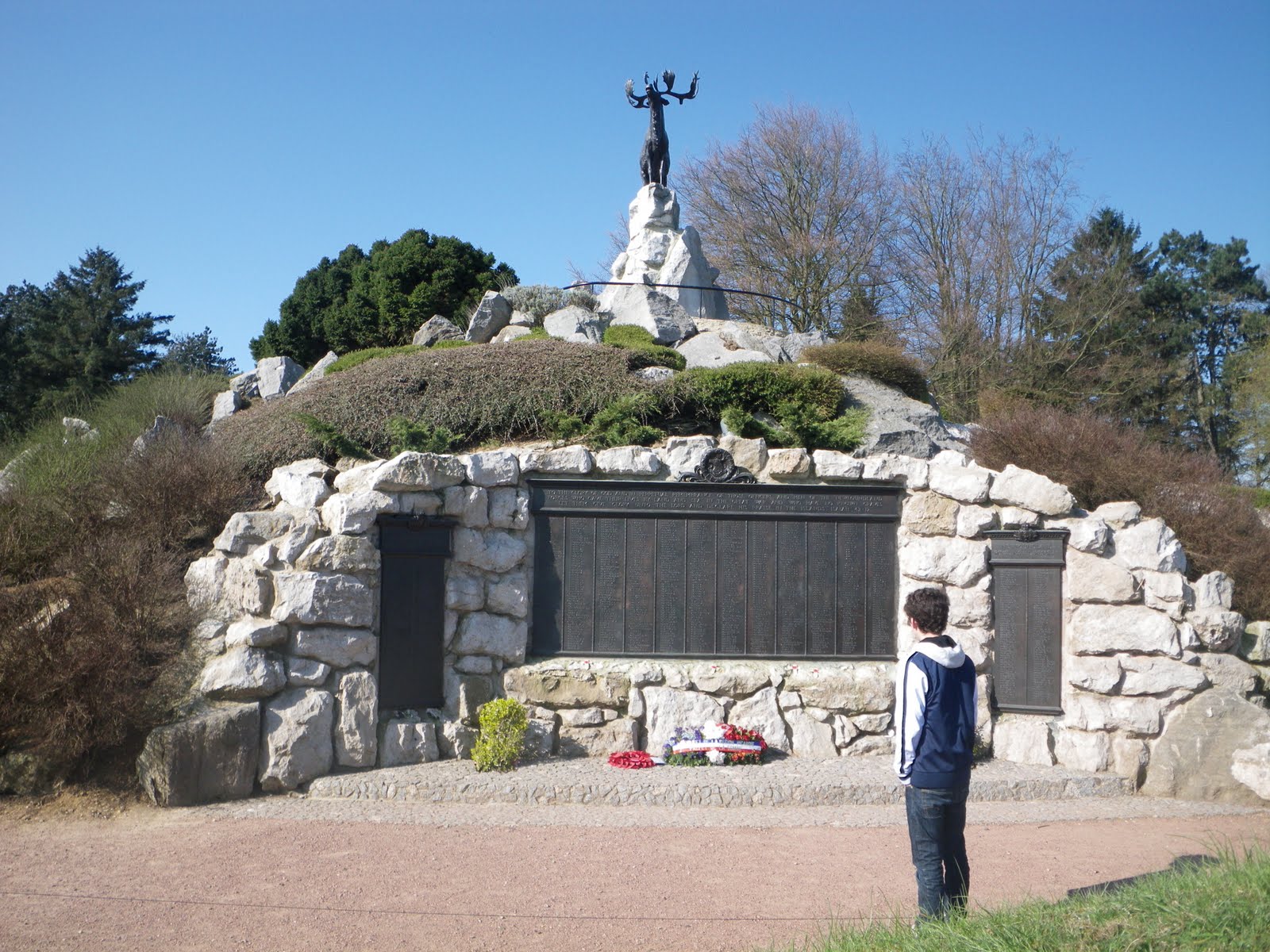
The Newfoundland Regiment attacked as part of the second wave, at 9.15 a.m. Within half an hour they had suffered terrible losses, with more than 90% becoming casualties. Set into the stones at the base of the mound on which the caribou stands are three bronze panels listing Newfoundland's missing. The central panel (pictured below) lists the missing of the Newfoundland regiment, whilst the two smaller panels on either side list the naval and mercantile missing.
The caribou was chosen as the symbol for memorials to the Newfoundlanders, and similar statues are also located at a number of other sites on the Western Front where the regiment was in action.
The original trenches and no man's land
From the Newfoundland Memorial Park we made our way to the Thiepval Memorial to the Missing. On the walls are listed over 72,000 soldiers whose final resting place is unknown.
Beyond the arch is a cemetery with both French, on the left and British grave sites. There were no Canadian troops involved in the battle for Thiepval, but we did find the graves of two unknown soldiers from the Royal Canadian Dragoons. We placed a poppy at each grave.
In driving around the Somme River valley we saw this tower of in the distance and decided to investigate.
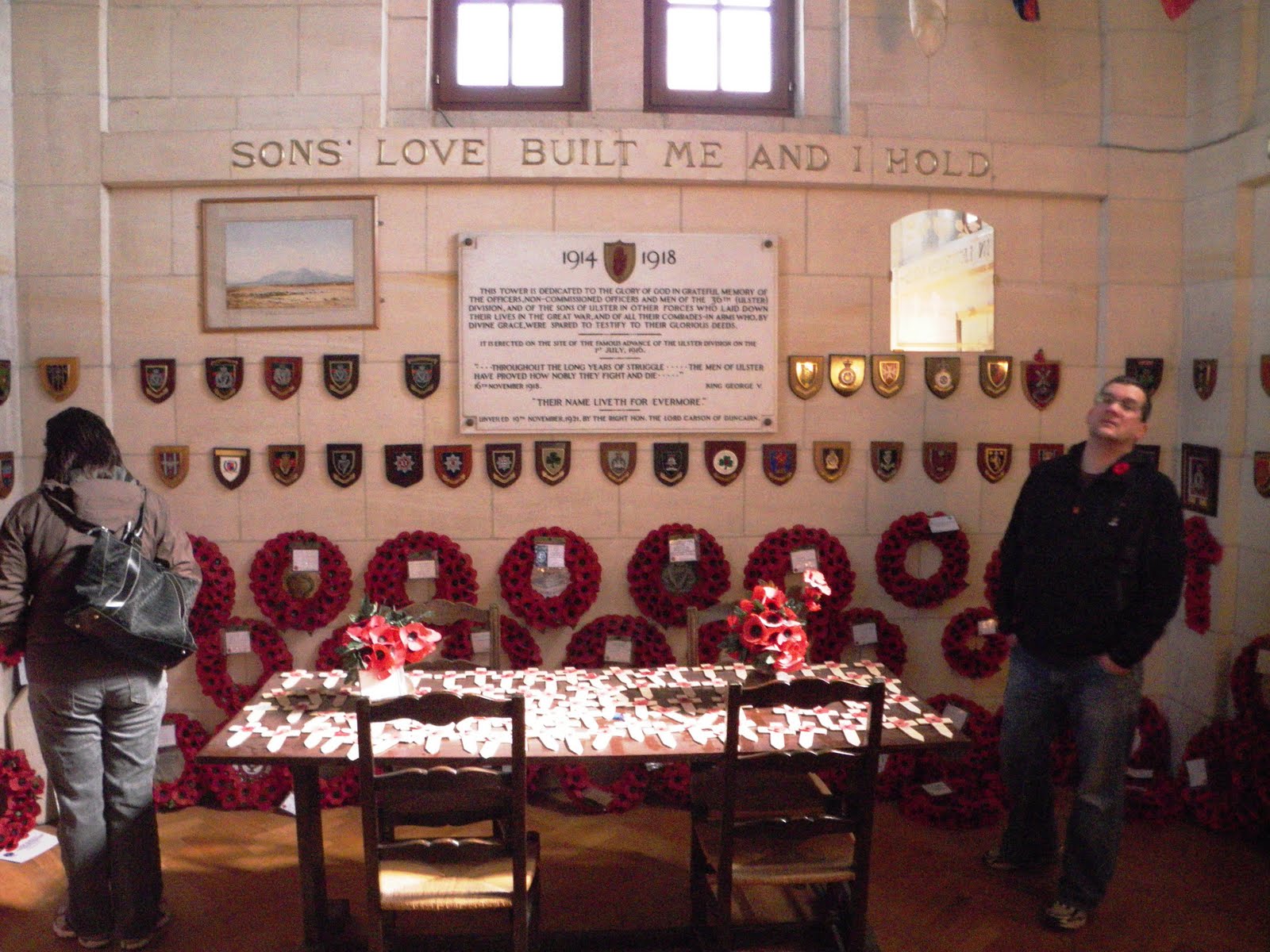
The Ulster Tower is a memorial to the men of the 36th (Ulster) Division. It is located very near to the famous Schwaben Redoubt (Feste Schwaben) which the Division attacked on July 1st, 1916. The Scwaben Redoubt was a little to the north-east of where the tower stands, and was a triangle of trenches with a frontage of 300 yards, a fearsome German strongpoint with commanding views.
The tower is a copy of Helen's Tower in County Down, where men of the 36th Division trained. The tower (plus a small cafe nearby) is staffed by members of the Somme Association which is based in Belfast.
Jeff handed Maeghan the door stop, spent artillery shell. The first floor is devoted to the memory of the soldiers while the upper floors are for the staff who run the canteen and look after the grounds.
Lunch break was in a town with a name that fails me right now, and probably forever. The only memorable thing about the town was this Morgan Roadster which we first saw at Menin Gate.
After a late lunch of kabobs, the only restaurant open on a Sunday, we made our way to the Lochngar Crater Memorial.
The Lochnagar Crater, at La Boiselle, is privately owned by Richard Dunning, having been bought in 1978 to save at least one of the original 1 July 1916 Somme craters from being filled in and built upon by local farmers.
An annual ceremony takes place every year at a wooden cross at the crater on 1 July to commemorate the first day of the Somme offensive.
The crater itself was caused by two charges of ammonal, of 24,000lb and 30,000lb.
It was blown along with 16 others at 0728 on the morning of 1 July 1916 as a two-minute precursor to the start of the offensive. The Lochnagar Crater measured 300ft across and 90ft deep (200ft wide and 81ft deep by 1919).
Debris from the explosion rose some 4,000ft into the air.
After the crater was blown the crater, which was in German hands, was charged by the Tynesiders, without success, for by the time the attack was made following the explosion the Germans had regrouped and repelled the oncoming British.
However the Worcesters took the area around the crater two days later on 3 July.
We ended the evening back in Lille, France where we had supper and an early evening; all very tired after a full day.
Subscribe to:
Posts (Atom)