


 After our little excursion of Monks Wood on Saturday we thought a roast beef dinner at the Greenman was an excellent outing for the day. The dinner, as always, was very delicious and very, very filling. Unfortunately I had my first mediocre cask ale, a Davensports Busy Man. It was a very light, very sweet ale that was not to my taste; ah well, I have to expect a few of those in my travels. After the carvery we checked out the self-serve eggs and vegetable stand across from the pub. Pick out what you want and pop the coins in a cup.
From there Jeff took us to St Swithin's church to see the graves of four Canadian airmen buried in the cemetery. If you go to this link, the four airmen are listed at the bottom of the page. The story is that these four airmen while on a training mission during WWII, struck the top of the steeple of St Swithin's church and died in the crash of their bomber. The steeple was replaced and the new addition can be seen as a light grey in the photo. The old top of the steeple is still on the grounds of the church.Last year Canadian soldiers held a Remembrance Day service at the cemetery presided over by Jeff's mother Chris, a United Church Minister.From there we made our way home via St Andrew's church, Wood Walton. The earliest part of the existing structure is the South Arcade which dates from the mid 13th century. The church was declared redundant and officially closed in 1972. Vandals all but destroyed the church in the following years. It was saved by the charity The Friends of Friendless Churches.Another full day and by full I mean I ate too much at the Greenman and had to almost rolled into the house where I slowly recuperated enough to have some dinner.


 Saturday seemed like a good day to check out Monks Wood,an ancient wood a short drive from Abbots Ripton. Jeff had scouted out this area earlier as a possible site for up to 5 caches. He had spoken to the ranger in charge and had a tentative go ahead.One of the things that I enjoy about geocaching is the discovery of new and interesting places. In Kingston, Ontario I discovered areas and sights in the city that I didn't know existed. In placing caches in Monks Wood, Jeff hopes to introduce the ancient wood to other geocachers.Our aim was to find a few spots where Jeff could establish caches. This mainly involved finding a hollow tree or tree stump, taking a picture and entering the spot into the GPS receiver so we could find it again. Caches must be at least 100 metres apart so we saw a good deal of the wood. One other use of the GPS receiver is to record our journey as a track, which can be later viewed on a computer and compared to the map of the wood to see what areas we had travelled through. We found we had covered about half of the major trails in the wood.Flora and fauna were almost non-existent, save for a few starlings and the odd squirrel. The wood has resident populations of rabbit, hare and fox, but we saw none of these, although J.J. would frequently pick up the scent of something as we walked along."One of the biggest influences on the wood over the last 20 years has been the enormous increase in the numbers of deer. Muntjac deer are extremely common and cause great damage to flowering plants, shrubs and trees, especially saplings. Muntjac were introduced to Britain from Asia in the 1920’s, and have since spread over most of Southern England. They breed all the year round and have few natural predators. The deer are controlled by culling, and two large areas have also been fenced off to protect the vegetation from deer and to monitor their long-term impact on the wood.
"
We found a few deer stands along well defined pathways and Maeghan just had to try out her climbing skills.We were able to find six possible sites for caches in about 1-1/2 hours of wandering. Jeff will present these to the ranger for approval and if all goes well we will return to place the caches. All agreed it was a good day's outing.




 Saturday morning found us on the road to a Geocaching Event on the north shore of the Thames Estuary, near Southend-on sea. A Geocaching event involves someone posting a notice on the Geocaching website that they will be hosting a gathering for all who wish to participate, usually at a place that has some significance, be it geographic, historical, or ecological. In this case it was at Hadleigh Country Park in a reconstruction of an Iron Age Round House. What also interested us was the longest Pleasure Pier (sounds naughty) in the world located at Southend-on-sea. So we set off early in the morning in a landscape entirely covered with hoar frost; all of the trees, even the tallest were covered with frost. It made for a surreal landscape.We were on the road for less that an hour when we pulled off on a country lane for a quick grab of a cache at St. Giles church. This church had seen a lot of reconstruction, with the east end being mortar and rock decorated with flint nodules.
I have included Leigh Smith's reply to my query about the black rocks for those who are interested. For those who are not just skip the italics..
They formed when the tiny siliceous fossils that had been deposited in the calcium carbonate "soup" (sediment) of the Late Cretaceous were dissolved and then precipitated as quartz around small quartz silt grains in the sediment. Over time , this process formed the nodules we see today. (the very small amounts of organic matter that were present also collected there and, thus, the black colour typical of most "flints". Thus , flints in the chalks!It is always fun to see if the local church in BBC Mystery TV stories has walls of flint. This guarantees that the featured village is situated on chalk!! Those medieval characters were notinto make-work projects! They used the local materials!And once upon a time those chalk ridges were covered in flint nodules, from the differential dissolution of the calcium carbonate portion of the chalk. Now a days the ridges are just grasscovered , as those old guys had collected all the durable building materials long since!! (And those English types think grass is the natural state of those ridges!!! ) All the flints are gone and the trees that once were there have long since been cut down - for charcoal.
The west end of the church boasted a wooden spire supported by brick walls containing very old irregular bricks supported by 'S' shaped brackets and modern bricks.
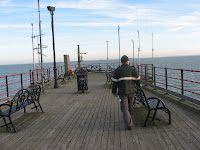
Our next stop was Norsey Woods, a 165 acre woods with a 4000 year history. The hoar frost was still with us as we set out on a well-groomed path.Our first cache brought us to a tumulus, a Bronze age burial mound, in which the cremated remains of two humans were found.Our second cache took us deeper into the woods to a portion of the Deer Bank, a massive ditch and bank constructed by medieval land owners to to protect their wood, timber and hunting rights. The banks kept the deer in and the cattle out.Our next stop was The Duke's Head where we had a very filling lunch in front of a coal fire. Once again Alexander had to settle for a hamburg without the French's Mustard he so loves. I was able to sample another fine real ale, Adnam's Southwold Bitter. So far all the ales I have sampled have been excellent.After lunch it was on to Southend-on-sea to check into the Gleneagle's B&B and then see the sights. The kid's were jumping for joy when we found that there were carnival rides and ARCADES!!!; more legalized gambling for minors. Maeghan and Alexander had money to burn and the energy to try out every arcade in town, or so it seemed. Luckily there were pubs interspersed among the may arcades.We had tried to take the train out to the end of the pier, but was told the pier was closed because it was too cold(?).We made it an early evening as the next day was to be a busy one. Unfortunately only Jeff and I had a decent sleep; I kept Alexander awake with my snoring and J.J. kept Maeghan awake with his licking and pacing.Sunrise the next morning was cool, crisp and clear. I took J.J. out for his morning ablutions and newspaper reading and shocked another guest, who was bundled up in a coat, scarf and hat. I was just in jeans and a T shirt and I heard him mumble 'must think it is spring, daft colonial' or something to that effect.After a delicious breakfast (I was tempted to try a kipper) we set off to meet some other geocachers and do a multi-cache (find three caches that would give hints to the coordinates of the final cache) in the town before heading off to the event.After a few wrong turns we found the Hadleigh Country Park and the reproduction of an Iron Age Round House. We checked in, said our hellos, picked up directions for the event caches and struck out into the park. We decided to do only a couple of the caches as the whole route was 5 kilometres long on muddy trails. It was a warm, sunny day so we drove back to Southend, hoping that we would find the pier open. Sure enough it was and we took the train out to the end, 1.3 miles out into the Thames Estuary. The only building we found at the end was the Lifeguard Station; there were remnants of other buildings destroyed in the fire of 2005. I think the kids were hoping for some more arcades, but they were disappointed.Jeff and I fired up our GPS units and we started back to the mainland, looking for a cache located somewhere about halfway along the pier. We located the shelter where the cache was hidden and it almost eluded us, but as we were leaving a last quick look by Jeff showed us the cache.We ended our day on that positive note and headed home.After we had finished our lunch on Saturday I loaded the coordinates for the Duke's Head into my GPS unit and it took us no time at all to find it on our way home. Jeff, Alexander and I opted for the roast beef dinner, while Maeghan, on a recommendation from Alexander opted for the hamburger (without the mustard). I wanted to sample another real ale but the other tap boasted a picture of Santa Clause and as I was unsure how much Elves knew about brewing beer I was prepared to have another Southwold Bitter. The bartender (is that the proper term over here?) pointed out that they had another Adnams ale - Broadside, so I tried a pint and it went down so well I had another.With Maeghan plugged into her iPod and Alexander watching a movie we had a quiet drive home.


 Jeff, Louise, Alexander and Maeghan have been to the farthest point west and farthest point south in the British Isles, so once we discovered there was a geocahe entitled Farthest Point East we just had to go after it. We set off early in the morning and after a 2 hour drive, in which I saw some new countryside while the kids (Maeghan, Rhiannon, and Alexander, with Jeff as referee) in the back watched a movie, we arrived in the village of Lowestoft. The first coordinates to the geocache brought us to a large compass rose on the breakwater. The outer circle of the the compass rose listed the distance to cities in England and Europe. By locating certain cities and their distances we were able to calculate the coordinates to the actual cache. After a short, very cold walk along the breakwater we found and signed the cache. We beat a hasty retreat to a pier to warm up and found an Arcade. Actually it was a form of legalized gambling for minors with many games of chance played with 2p coins. After warming up we headed out looking for a place to eat. We found the Thatch, located on the beach, and tucked into some excellent food. I tried the local Suffolk sausages with chips and peas. What is it with the English and their peas. Most entrees are offered with either a salad or peas (sometimes mushy peas), no carrots, no broccoli, no mixed vegetables, just peas. I mean, I like peas, but I also like variety. After lunch and a quick walk along the sand beach we headed off for our next cache. There we found eroding cliffs and the village of Covehithe, a village destroyed by the advancing North Sea. It was interesting to see the 'new' St Andrews (1672) built within the original St Andrews. As far as I can make out the old church was defaced by the Puritans around, but they did little structural damage. In 1672 permission was granted to erect a smaller church using materials from the large church. I would assume, once the roof was removed, the old church soon deteriorated. I was interested to see that the walls of the church are made up of fist-sized boulders and lots and lots of mortar. Some of the outside walls are decorated with shaped pieces of a black rock. I must remember to email Leigh Smith, a member of St George's and a professor of geology and ask him about the black rock. Part of the requirements of the cache was, give the rate of erosion, to estimate how long would it take for the cliffs to threaten the church. We estimated that in 75 years the church would cease to exist. Our next cache took us to the village of Southwold. We were directed to a pier, where, surprise, surprise, there was another arcade. We left the underage gamblers and went after the cache. We were directed to the middle of the pier to answer the following questions; 4 fillies visited - when ? 4 old nags returned - when ? and what were their names ? I went looking for the clock, a strange, water-powered sculpture, that performed on the hour and half-hour. Since I found it at 35 minutes after the hour, and as it was a cold, damp day, I decided to forgo the experience. I wandered on down to the end of the pier and found some dedicated fishermen trying their luck. One couple was sheltered behind a huge umbrella and the other has a free-standing tent. I thought this was a bit much until I remembered the hardy souls in Canada that venture out onto the frozen lakes to sit and stare at a hole in the ice for hours at a time. At least here they had more to see and a cafe nearby to grab a hot cuppa. Jeff and Louise solved the riddle by finding a plaque on the railing that gave the answers to the questions posed by the cache. The top of the railings on both side of the pier are covered with memorial plaques of visitors to the South Pier. I am assuming that the placement of theses plaques was a way of funding the upkeep of the pier.
Our next cache took us to the town of Aldeburgh, and onto a Ness (Over the last 10,000 years the sea levels off the Suffolk coast have started to rise by an estimated 2mm a year. This changing relationship between land and sea has meant that the coastline is being constantly altered. One geological change is the accumulation of shingle banks along the coast. These banks are known locally as Nesses. There are many of these in East Anglia - others local nesses can be found at Benacre, Kessingland, Languard Point and Thorpness. Originally the mouth of the river Alde was at Aldeburgh. However as the shingle bank has grown, the river has been diverted to the South, causing it to run parallel to the sea. In the 16th century the river mouth was at Orford but now the river finally reaches the sea at Hollesley Bay, 16km from its original outlet. This makes Orford Ness the largest vegetated shingle spit in Europe.)On the Ness we found an "inhabited" Martello tower. Jeff did some investigating when we arrived home and found that the Martello tower was part of the Landmark Trust and could be rented for the weekend. I ordered the Landmark Trust handbook which lists many properties in England and Scotland that can be rented by the general public. We may be able to spend a weekend in a lighthouse, bunker or castle!We also found some more avid fishermen on the Ness, all dressed in their North Sea survival suits. We left them to their fun(?), called it a well-spent, interesting day and headed home.

 Two photos describe what we did on New Years Day. Happy New Year everyone.


 Jeff and I were feeling a little bit of cabin fever so we decided to venture out and do some Geocaching. For those unfamiliar with Geocaching click on this link to find out more; About Geocaching.
Our first stop was in Stukeley, a village not too far from home. We followed the directions given by our GPS units and ended up in what I would have called a subdivision; but a subdivision in miniature. I am used to 66 foot road allowances, road frontages of at least 50 feet, large front lawns and deep backyards. This subdivision was compact and with houses adjoining each other, narrow roads, and front yards just big enough to park a car in front of the house. There was room for a small patch of grass that was as often as not covered with flint shards, coloured stone, or pavement. Far different from a Canadian subdivision, but very appealing.
Our first cache was an eye opener for me. Winter caching is usually easier because there are no mosquito's, no leaves and no undergrowth. But even without all these it was a chore. Everything, and I mean every tree, shrub and plant had needle sharp barbs that reached out to ensnare me and prevent me from advancing. In Canada I have fought my way through wild raspberry canes, Juniper bushes, and wild rose bushes, but nothing prepared me for the English version of a jungle.
I spent most of my time extracting myself from the flora and it was up to Jeff to find the cache. It was a film canister lodged in the crook of a tree, hidden by ivy.
After signing the log and taking a picture we struck out for the next two caches, which were in walking distance of the first. They presented little problem to an avid cacher like Jeff and we were soon back in the car heading for the fourth cache.
This cache was located in Hinchingbrooke Country Park, just outside of Huntingdon. A creek barred our way until we found a bridge and we soon had the cache in hand. Another quick photo and we were off for a well deserved lunch.
We gave the pubs a miss and opted for pizzas at PizzaExpress. My favourite gourmet pizza restaurant, Atomica, is located in Kingston, Ontario. This chain of restaurants could certainly give Atomica a run for my money. This was my second pizza from PizzaExpress and it was delicious.
We soon headed home tired and content to rest up for New Years Eve.


